



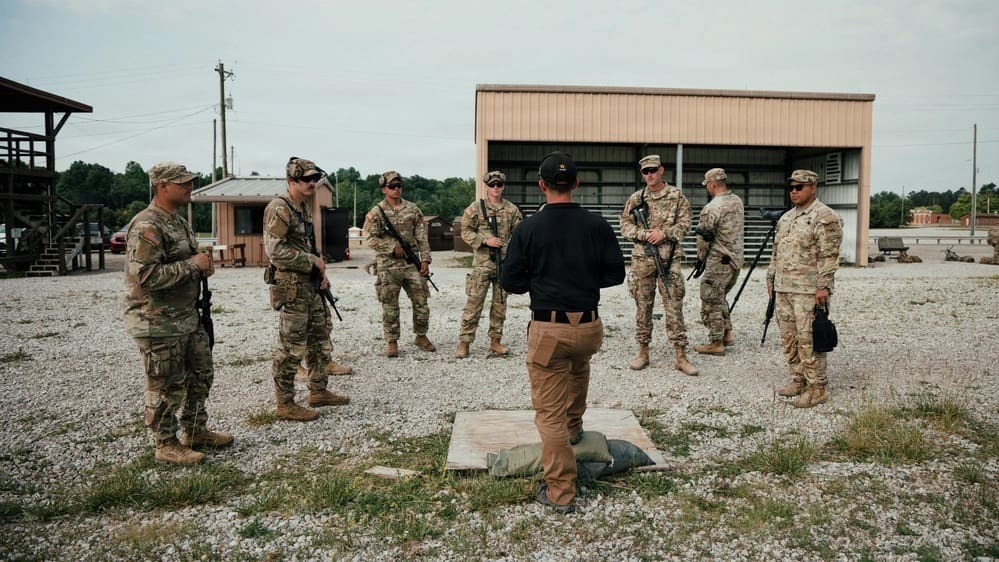


My AIWB posts from last year generated some strong opinions from both sides of the issue, and this is a good example of how the facts don’t care about your feelings. My time at Tac-Con last week reinforced my position on the issue. In my classes, I get pretty competent shooters, people who are safe to carry AIWB and who are willing to work on it if needed. Tac-Con, on the other hand, has a much larger variety of shooters. Some are world class and others are very new to shooting and training. Neither extreme is morally superior, but at the lower end of the skill and experience scale, safety is a real issue.
When I switched to AIWB, I was already an accomplished shooter. My strong side carry was fast and effective and safe. This is also true for most other shooters who I know and shoot with. Talking to many of the better shooters at Tac-Con, this was also true for them. I started with an IWB holster and back then, it just wasn’t really done that way. Thanks to the writings of Massad Ayoob, I knew I wanted better concealment than an OWB would offer me, so I figured I would learn to shoot from the holster I actually carried my gun in. Few people I came across back then actually carried in an IWB holster, and the few who did would often go to the range with an OWB holster. This was often billed as a “range holster”, in the magazines and holster catalogs of the day. It was perfectly acceptable back then, and while that seems dumb (or should) to us, it is really no different than the guy who carries AIWB or IWB but who goes to the range with his race rig or tactical rig – very common, even today.
Today though, when a new shooter wants to start carrying and training from concealment, they generally don’t start with an OWB holster like they did in the past. They start with AIWB. While it is certainly possible to do this safely and effectively, most new shooters are neither safe nor effective, and most don’t understand how to train correctly. All weekend at Tac-Con, I saw newer shooters struggle to holster their AIWB pistols. Some were wearing traditional belts and holsters, others were wearing various other contraptions. Their undershirts would ride up, their concealing garments would fall down. Their layers (it was chilly at times) interfered with their holsters. Some had larger energy stores than others and that interfered with their holstering as well. They needed their offhand to clear the problem and then they would get their off hand fingers into or near the mouth of the holster and help their strong hand guide the gun into the holster. Not everyone did this of course, but even among the shooters who were better at it, I rarely saw any forward hip movement when holstering, and the muzzle was brought back towards their body, rather than keeping it as outboard as possible.
AIWB is absolutely an inherently more dangerous way to carry a gun. If you don’t understand this, if you are in denial, please get some correct training and education and change your outlook and procedures before you have an accident. I have been safely carrying this way since the mid 90s (with some strong side thrown in, of course) and that is because I treat it with the respect it deserves. I also got a bit lucky, given some of the shenanigans I got up to. I mentioned this before and apparently not everyone understands how these things work. Anyone who has ever been in a fight, let alone a bunch of them, knows that luck plays a role. Skill may carry the day, but I know skilled guys who simply ran out of luck. As the old saying goes, I’d rather be lucky than good. Since none of us can count on just our skill or on luck, I will take skill and luck, anytime I can. I do believe that the better trained you are and the more realistic you are in your training and assessment, the more luck you will have.
So, perhaps a quick guide is in order. Before moving the gun off the target and back towards your holster, your trigger finger must go into the register position. That is, as high up on the side of the gun as you can, without straining your finger. If you have a gun with a hammer or a Glock with a gadget, your thumb goes onto it as the gun rotates down towards the muzzle. Your support hand clears your garment as your hips kick forward. Your muzzle points down range as much as it can, while moving into the open holster that is also pointing more downrange than back at you. One of the big advantages to a good wedge is that it cams the holster mouth back towards you, keeping the muzzle end angled towards the target a bit. This ensures that the muzzle does not cover you as you holster. You look at the opening of the holster while you are doing this to ensure nothing gets in the way of your gun. Once the gun is fully seated in the holster, you can take your hand off the gun, fix your concealing garment and stand up correctly, hips back underneath you.
The above procedure is not hard to do, and it is not slow. I taught a shooter to do it this past Friday, with less than 4 magazines of live ammo and a few reps dry. After an hour of general practice, he was drawing and reholstering just as fast as he did before from his OWB range rig. If your favorite instructor can’t or doesn’t teach like this for – new to AIWB shooters – they are not qualified to be teaching AIWB. Find another. If you are new to shooting and new to AIWB, practice at home dry as much as it may take for you to be completely confident that you will get it right under stress. Some people learn new physical skills quickly, others need more time. Carrying a gun is supposed to make you more safe, not less, but it is not magic. It is up to you to do the work.
Read the full article here
