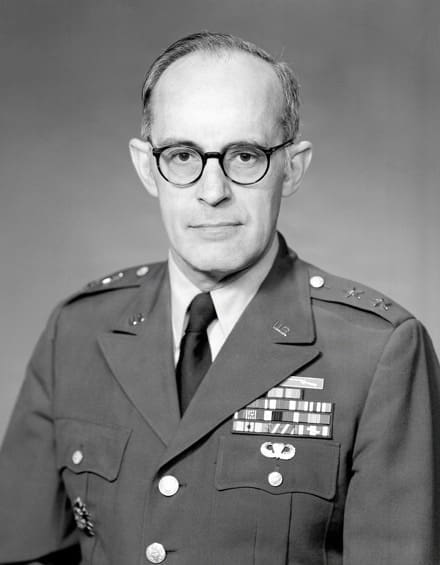


On July 21-22, 1982, Maj. Gen. William Odom, the Army’s assistant chief of staff, intelligence, hosted a Tactical Intelligence Conference at Fort Huachuca, Arizona. With a goal of finding consensus on the Army’s long-awaited intelligence capstone field manual, FM 34-1 Intelligence and Electronic Warfare (IEW) Operations, the conference was an overwhelming success.
The 1970s ushered in dramatic change for Army intelligence. Specific reforms recommended by the Intelligence Organization and Stationing Study (IOSS) published in 1975 were being implemented: the U.S. Army Intelligence and Security Command had been established; responsibility for all intelligence training was consolidated at the U.S. Army Intelligence Center and School (USAICS); and planning was underway for a single Army intelligence production center—the Army Intelligence Agency. Additionally, organic combat electronic warfare intelligence (CEWI) units were being activated at corps and division levels; yet intelligence doctrine struggled to keep pace with this rapid organizational and operational change. As late as 1982, MI was still relying on doctrine published more than a decade earlier.
At USAICS at Fort Huachuca, Mr. Phil Young’s Doctrinal Literature Division, Directorate of Training and Doctrine, was tasked with producing all IEW doctrinal materials for the U.S. Army and some joint services. The office had several supporting FM 34-series echelon manuals—such as FM 34-20 MI Group (CEWI) (Corps) and FM 34-10 MI Battalion (CEWI) (Division)—in various stages of completion, as well as a rough coordinating draft of FM 34-1 completed as early as 1980.
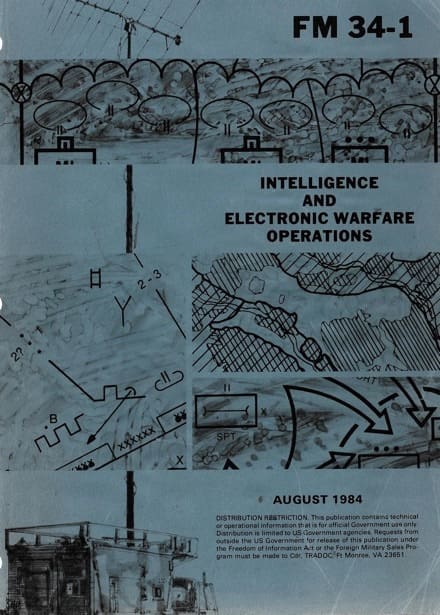

Two years later, tactical units were complaining about USAICS’ failure to produce a final version of the capstone manual. FM 34-1 was proving a significant challenge for Young’s office. Not only was Young struggling with significant personnel shortages, but the draft received some contentious feedback from the field. In a column in Military Intelligence Magazine, General Odom called out the “wholly unrealistic expectations” of the critics, stating “Two or three years ago, I doubt that we had adequate experience on which to base an effective draft of FM 34-1.” While he believed that “a great deal of experience has begun to accumulate from exercises and training,…we are nowhere near ready to write the ‘last word’ on doctrine in FM 34-1.” Still, he agreed, “it is high time to write the ‘first word’ on that doctrine.”
On July 21-22, 1982, General Odom convened a Tactical Intelligence Conference at USAICS. He brought in Army G-2s and tactical intelligence commanders from every corps and nearly every division to collaborate with the doctrine writers at USAICS. After personally helping nail down a definition of “doctrine,” Odom focused the attendees on five key areas of dissension: IEW operations, intelligence support to Operational Security (OPSEC), the all-source intelligence center, collection management, and joint and combined IEW operations.
After the conference, General Odom praised the level of competence and professionalism in the MI Branch, relating, “The wealth of insight was truly impressive, and I personally left the conference much richer from the experience.” The USAICS doctrine writers also felt enlightened but perhaps intimidated by the amount of material the July “crash effort” and a follow-on November session generated. Still, based on the two conferences’ recommendations, by the end of the year, Mr. Young’s division had hammered out a new FM 34-1 coordinating draft and staffed it for review by the major commands. A second coordinating draft—slimmer by 250 pages and focused on company and field grade officers performing IEW command and staff functions—was ready for staffing by Feb. 18, 1983. On Mar. 22-23, 1983, another meeting at Fort Huachuca led to the finalization of the manual’s content.
Finally, on Aug. 31, 1984, the long-awaited FM 34-1 IEW Operations was published, the first time Army intelligence field operations doctrine was compiled in a single source. It provided general doctrine for tactical IEW operations from Echelons Above Corps down to maneuver battalion levels. Mr. Young stressed, however, that the manual was still not “the last word” but, instead, would need to be updated with continual feedback from the field.
Article by Lori S. Stewart, USAICoE Command Historian. New issues of This Week in MI History are published each week. To report story errors, ask questions, request previous articles, or be added to our distribution list, please contact: TR-ICoE-Command-Historian@army.mil.
Read the full article here