



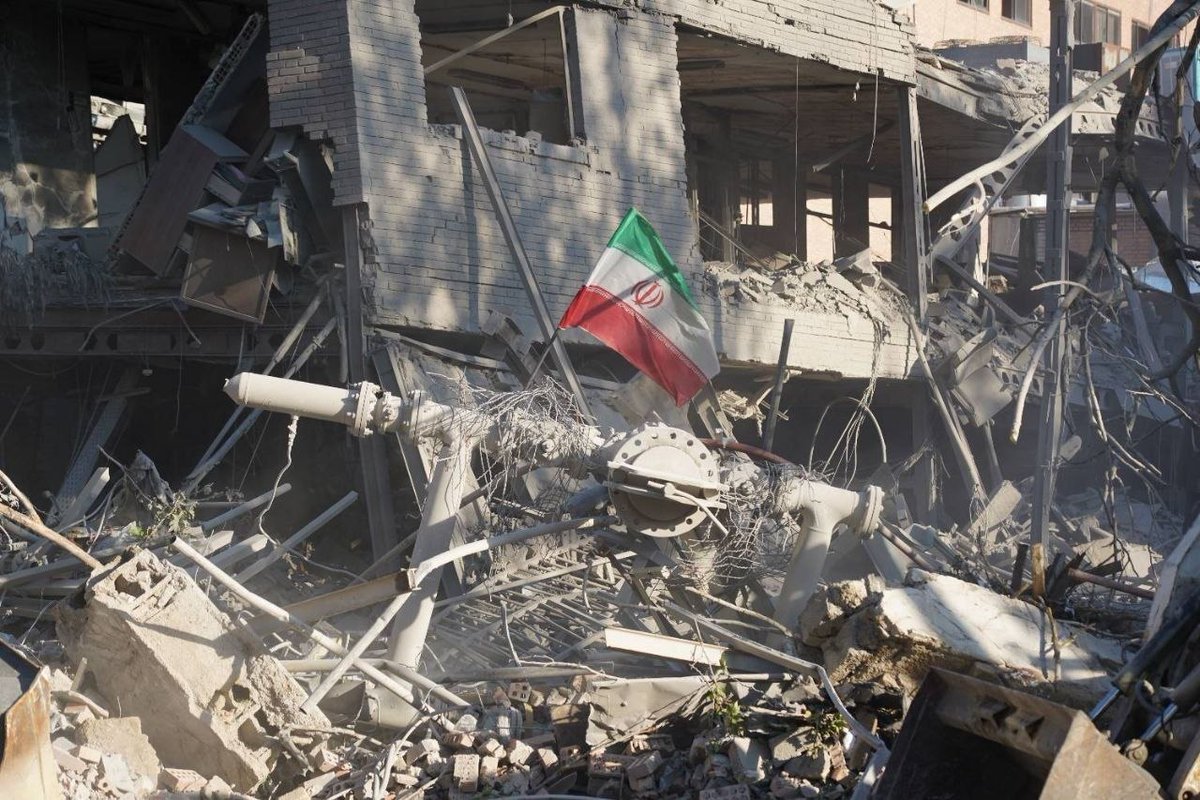
The Iran War entered its 38th day as more details emerged about multiple aircraft destroyed in Iran over the weekend during reported search-and-rescue operations.
The U.S. reportedly managed to seize an “abandoned airport,” 200 miles deep inside Iran, near Isfahan, where Iran’s largest atomic scientific center is located. The U.S. is said to have landed two Lockheed Martin MC-130J military transport planes with hundreds of special forces and other military personnel. U.S. officials claimed personnel then deliberately destroyed those aircraft to prevent Iran from capturing sensitive technology after the planes malfunctioned, while three new planes were deployed to rescue the forces.
Tasnim published photos of the destroyed U.S. aircraft in southern Isfahan while Iran’s foreign ministry said the U.S. mission may have been a cover operation to seize enriched uranium, with spokesman Esmaeil Baqaei saying on Monday that “the possibility that this was a deception operation to steal enriched uranium should not be ignored at all.”
No name, photo, or interview has so far been produced of the weapons systems officer the U.S. government says safely ejected from one of the downed F-15 jets.
Axios claimed on Sunday evening, citing anonymous “Israeli, U.S., and regional sources,” that “the U.S., Iran and a group of regional mediators” are “discussing the terms for a potential 45-day ceasefire that could lead to a permanent end to the war.” The story was written by Barak Ravid, a former Israeli military intelligence officer, whose past reports on diplomatic activity Iran has denied.
Iran’s Tasnim News Agency said that Iran has rejected temporary ceasefires that leave the threat of renewed war in place. Such pauses, Iranian leaders worry, would allow the U.S. and Israel to resupply and preserve strategic pressure on Iran without meeting Tehran’s conditions for ending the conflict.
Iran has said that its terms for permanently ending the war include a long-term guarantee that the U.S. and Israel will not attack Iran again and that any ceasefire also apply to Lebanon, Iraq, and Palestinian territories; reparations for damages done to Iran during the war; sanctions relief; and for Tehran to retain control over the Strait of Hormuz.
Israel’s Defense Minister Israel Katz on Monday announced Israeli strikes on Iranian civilian infrastructure targets at the South Pars complex in Asaluyeh. “The IDF has now powerfully attacked the largest petrochemical facility in Iran, which is located in Islava,” Katz said in a video address. “Now the two facilities, which together are responsible for about 85 percent of Iran’s petrochemical exports, have been put out of use and are not functioning.”
Sharif University of Technology in Tehran, one of the world’s top science and engineering institutions, was bombed overnight, with Iranian Foreign Minister Seyed Abbas Araghchi writing on X that “Israeli-U.S. aggressors have bombed the MIT of Iran,” warning that “aggressors will see our might,” in response.
Iran struck energy and industrial infrastructure across the Gulf overnight, damaging civilian facilities in Kuwait, the UAE, and Bahrain.
In the UAE, authorities said debris from intercepted drones and missiles sparked fires at the Borouge petrochemical plant in Ruwais, while Abu Dhabi National Oil Company (ADNOC) was forced to suspend operations at its Habshan gas facility due to damages from Iranian attacks. Satellite images show ongoing fires at three major UAE oil and gas sites, in Asab, Habshan, and Bu Hasa.
Kuwait’s military said Monday it was responding to hostile missile and drone threats as Iran struck multiple sites for a second straight day. Kuwait Petroleum Corporation reported severe damage, while authorities said two desalination plants and a government office complex were among Iran’s targets.
Iran’s Fars News reported, citing the Islamic Revolutionary Guard Corps, that a U.S. amphibious assault ship and helicopter carrier came under Iranian fire, forcing a retreat to the southern Indian Ocean.
Subscribe Today
Get daily emails in your inbox
Attempts by QatarEnergy tankers carrying liquefied natural gas to cross the Strait of Hormuz were aborted on Monday, according to marine tracking data. No tankers carrying LNG have been allowed to pass through the Strait since February 28. It was reported on Monday that Turkey has negotiated the passage of three Turkish-owned vessels through the Strait.
The price of Brent crude was $109 per barrel on Monday morning while gas prices continued to rise, with AAA reporting the national average gas price at $4.12.
Read the full article here