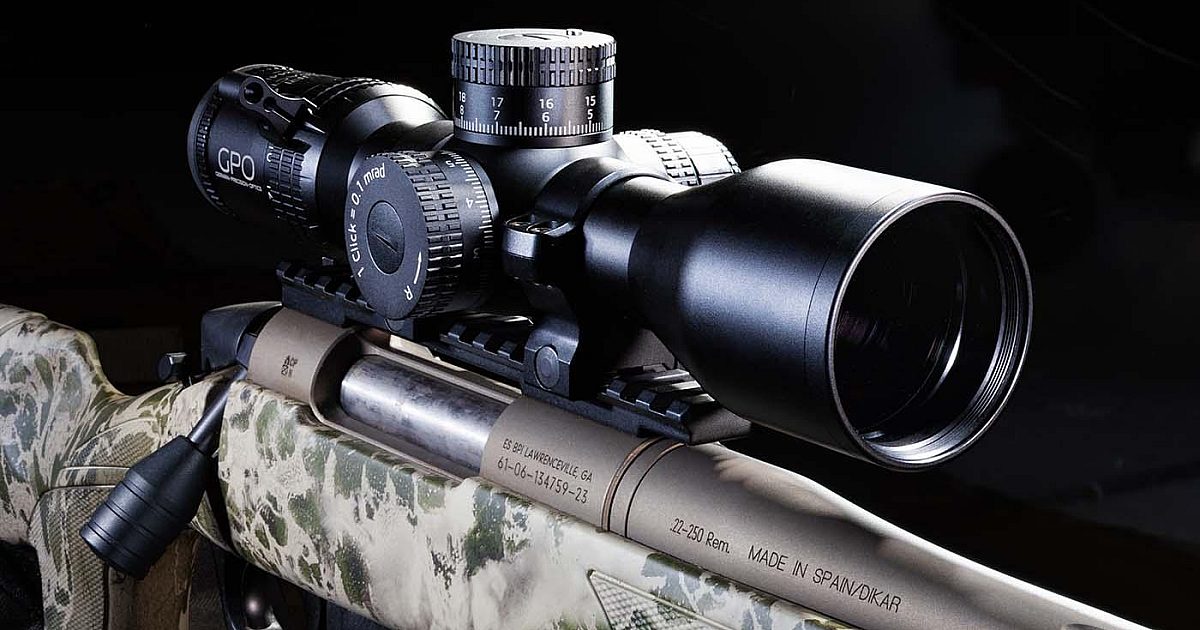


Media coverage has been glowing for the new GPO (German Precision Optics) Centuri 4X 4-16x44i Compact scope since its unveiling. It’s won awards, been featured in magazines, dominated blog headlines, and trended on social media channels — despite some its biggest assets rarely being mentioned.
You’ve likely seen the coverage but still wonder how well it will sell in a display case swimming with competitors. Industry buzz attracts attention, but curiosity doesn’t always make cash registers ring.
Out testing indicates it performs, is consistent in every way and is utterly reliable. Rather than starting with those findings, let’s begin with a couple of the under-reported details tactical retailers and their customers deserve to know.
We compared the GPO Centuri 4X 4-16x44i Compact scope’s specifications against the averages of four popular-selling 4-16x riflescopes (of more traditional length). Out of respect for each manufacturer’s hard-earned reputation for delivering quality in everything they make, we are withholding their names in this cursory survey.
Admittedly, price points varied as did object lens sizes — either 44 or 50 mm — in those included competing optics. It’s not quite an apples-to-apples comparison, but unlike conclusions delivered by a writer or influencer, the results are numbers, not opinion. One discovery was so surprising we asked GPO to doublecheck its figures and to explain how it’s even possible.
It’s the scope’s short stature that dominates headlines, so we’ll start there.
Tape Measurements
Rail space is prime real estate for customers and increasing in value with every SBR and AR pistol sold. More than a few customers will be shocked when they learn how GPO’s Centuri 4X 4-16x44i Compact scope’s reduced length stacks up against others.
The GPO is 9.9 inches long, an impressive figure that stands on its own. The number takes on an all-new meaning when you mention the average length of the surveyed 4-16Xs from four major competitors is 13.45 inches. Eliminating roughly 33½ inches will get the attention of most gun owners.
A customer might indicate his or her traditional-length scope is below that average. Data from only four highly regarded riflescopes with identical zoom factor and magnification were used for the calculation, not dozens. Odds are good you have at least three of those we did include in your inventory, so don’t be afraid to pull one out for a side-by-side comparison.
The abbreviate length is the headline grabber, but there were other unexpected discoveries in the numbers. The ability to acquire a target faster, regardless of magnification, was an unexpected advantage.
Downrange Yardstick
Every rifle shooter is familiar with the time-consuming wander that follows when a downrange target isn’t immediately visible through an optic. Finding it often requires reducing magnification, centering the target in the view and zooming back in. That takes seconds (or longer), precious commodities in competition and elsewhere.
The GPO field-of-view [FOV] numbers at 100 yards are 34 feet at 4X and 9 feet at 16X. The quartet of popular scopes averaged 26.6 to 6.5 feet at the same 100.
Honestly, with the optic’s shorter length, we expected a reduction. German Precision Optics confirmed its published numbers were accurate and explained in an e-mail that the shorter focal length “….allows the image to escape the objective at a broader angle.”
There is a tiny drawback. The company spokesman said, “If you notice, the only slight sacrifice on the scope optically isn’t the eye relief, but the eye box sensitivity. You have little play in attaining the full field of view. Experienced shooters don’t see this. They have an instinctive feeling on getting the eyebox field accurate. Beginners might see the sensitivity. This narrower eyebox allows, somehow, the stretching of the FOV.”
It’s a tradeoff invisible to most shooters, something relative newcomers will familiarize themselves with quickly with practice. There’s more, though.
High and Wide
The GPO Centuri 4X 4-16x44i Compact, which comes with a first focal plane (FFP) milliradian (mrad)-based reticle, has a 22-mrad maximum elevation adjustment. That’s roughly 78 minutes of angle (MOA). The traditional-length 4-16X scopes averaged 68.5 MOA. Only one member of the surveyed quartet beat the GPO — by 7 points, if you’re keeping score.
In windage adjustment, nothing came close to the Compact’s 36 mrad, which convert to more than 100 MOA. The scope’s competitors averaged slightly less than 65.
Weighing In
Weight of competitor scopes came in at 22.8 ounces, averaged. The GPO tips the scales at 20. It’s a tidy reduction, but it won’t open a customer’s pocketbook as fast as the improved field-of-view, abbreviated length and generous adjustment range.
The amount of precision German engineering squeezed into the scope is the likely reason why heft wasn’t trimmed at the same rate length was. This thing operates with timepiece quality, out of the box.
Confidence-Building Response
The tactical-style windage and elevation turrets elevate from the main tube by only about an inch. Despite that sleek profile, their roughly 1.4-inch diameter and generous texturing ensure a positive grip in challenging conditions.
To adjust point of aim, both are pulled away from the main body. An audible “click” signals the mechanisms are ready to shift. Changes are 0.1 mrad per click, and response is confidence-building crisp and palpable enough for fatigued shooters to feel and hear.
Pushing the caps toward the main body results in another reassuring click, signaling adjustments are locked in solidly. The system eliminates the ability for bumps and hangups to change settings.
The turrets also feature a multi-rotation indicator, zero stop and reset-to-zero function. There’s more, though.
Reticle and Parallax
Parallax and reticle brightness are adjusted by rotating dials on the left side of the scope. They stand out from the 30-mm main tube roughly 1.25 inches, slightly further than the windage and elevation turrets. The cover for the CR2032 battery — which powers the lighted reticle — contributes to most of that added distance.
Parallax is adjustable from 10 yards to infinity. It rotates click-free, but with a confidence-building feel that communicates an eagerness to stay in place. The ability to dial down to 30 feet is another noteworthy feature.
Reticle brightness settings can be dialed from 0 to 8 and anywhere between. There are no mechanical clicks however, and no off position between settings. You must remember to return to zero after use, or risk draining the battery.
All settings there, and at the turrets, are clearly visible in white to a shooter behind the rifle. GPO didn’t neglect some more common features we’ve come to expect, either.
Additional Features
The diopter is fully adjustable. Even it turns with a slow precision that indicates any changes will not be accidental.
A 3/4-inch throw lever rises from the magnification ring for fast operation. It’s a nice touch that offers a distinct advantage in a stressful situation, during competition or when the weather turns nasty. It can be removed, however. Doing so leaves a slight bump at its anchoring point on the magnification ring.
All GPO scopes are waterproof, sealed and gas purged. Add GPO’s fully transferrable “Spectacular Lifetime Warrantee” and tactical retailers can offer this scope to loyal customers in confidence.
Performance and Final Thoughts
Today’s CNC manufacturing has all but eliminated unwanted reticle shifts, loss of repeatability or imprecise windage and elevation adjustment. This scope didn’t violate that longtime trend, although we had to check.
Once zeroed on a .22-250 Rem.-chambered rifle, point of aim and point of impact didn’t wander after more than a dozen shots at different magnifications. That sequence was followed by maintaining aim directly at the target’s center, but adjusting windage and elevation — in an equal number of turret clicks — for the bullets to “print” the four points that define a square on paper downrange. The sides were equidistant, as predicted by the 0.1-mrad adjustments, and the scope returned to the original corner.
Set your zero, dial all day, and you can have confidence it will return. The Centuri 4X 4-16x44i Compact passed with ease, as expected.
The view is crystal clear and color rendition very nice. Contrast was ideal and low light performance was awesome at 4X. It seemed to sacrifice just a bit of its ability pick dark objects out in distant deep shadow at 16X, but it was still better than nearly every scope we’ve tested in this price range. The company’s GPObright lens coating technology does yeoman’s work, obviously.
The FFP HSi-CQB mrad reticle design makes getting on target intuitive and fast. It’s not a confusing Christmas tree look. It’s clean and familiar, and the U shape makes things faster at CQB distance.
When illuminated, the reticle is noticeable but not overpowering. It also somehow avoids the furry edges that plague some versions in the industry. Even at its brightest setting, there was little or no red fuzz on the borders.
The Centuri 4X 4-16x44i Compact lives up to the company’s precision name. It performs and brings with it a host of advantages of interest to any enthusiast. Its length is shorter than nearly all its identical-magnification contemporaries, it can improve target acquisition , and it comes with a reticle capable of delivering downrange while still performing when things get close. It’s a high-quality and innovative product any tactical retailer can offer customers in confidence.
Specs
GPO Centuri 4X 4-16x44i Compact
Manufacturer: GPO (German Precision Optics)
Magnification: 4-16
Objective Lens: 44 mm
Length: 7.1 inches
Weight: 16.9 ounces
Tube Diameter: 30 mm
Color: Black
Reticle: First focal plane, illuminated HSi-CQB mil
Battery: CR2032
Eye Relief: 3..75 inches
Field of View at 100 Yards: 4x: 34 feet, 16x: 9 feet
Accessories: Turret adjusting tool, Allen wrench, manual, lens covers, lans cloth
MSRP: $734.99
Website: GPO-USA.com
Read the full article here