


MARINE CORPS AIR GROUND COMBAT CENTER TWENTYNINE PALMS, Calif. —
During a live-fire exercise in support of Service Level Training Exercise 4-26 in coordination with the Provost Marshal’s Office Aug. 19, 2026, a new capability quietly demonstrated how the Marine Corps is adapting the rules of expeditionary force protection.
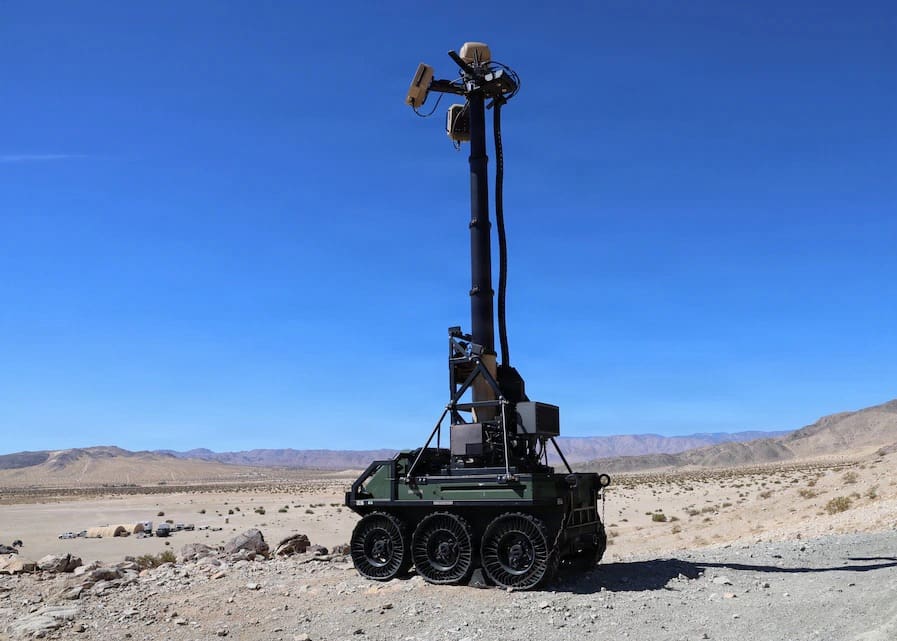
The Mobile All-Domain Observation and Sensing System (MA-DOSS), developed by Program Manager Ground-Based Air Defense (PM GBAD), successfully provided automated, continuous physical security during the event, proving that the cutting-edge system is no longer just a concept—it is now a deployable asset.
The nature of the event required the Marines to make sure that members of the public didn’t infringe onto the area designated for the exercise to prevent any dangers to those members of the public, and to prevent interference with the testing and operations on the installation. The system’s Artificial Intelligence/Machine Learning (AI/ML) driven automated target recognition quickly proved its worth when the integrated radar and camera capabilities in MA-DOSS allowed the operators to rapidly locate and verify potential ground incursions.
MA-DOSS instantly detected and classified the vehicle at the edge of the alert zone, alerting two Marine operators inside the command post. The operators verified the intrusion on their monitors and immediately relayed the tracking data to range safety personnel, ensuring the live-fire event remained secure without interrupting the training flow.
Historically, securing command posts and ranges during exercises has been a tedious, manpower-intensive task. Units routinely dedicated multiple Marines to manual surveillance using binoculars and radios. MA-DOSS directly fills this critical capability gap in force protection by acting as a mobile, sensor-integrated force multiplier that can track targets across the air, land, and littoral domains simultaneously.
While in operation, the system processes data on site to distinguish between natural clutter and incursions without passing heavy video feeds over tactical networks. By deploying advanced Machine Learning Operations (MLOps), in coordination with the Chief Digital and Artificial Intelligence Office (CDAO), MA-DOSS isn’t just detecting threats—it is continuously learning. This rapid feedback loop means the AI models adapt to the battlefield in real time, reducing false alarms and increasing operator trust.
“[AI implementation] is going to help us not just learn what the enemy’s already thrown at us, but learn what new systems may come our way in different ways and how the enemy may employ them,” explained Capt. Griffen Hedrick, PM GBAD’s MA-DOSS project officer. “So it’s not just a giant library of what they’ve done before, but predictions of the future.”
MA-DOSS represents a massive leap forward in mobility compared to the legacy Ground-Based Operational Surveillance System (G-BOSS). While the older G-BOSS towers were highly effective, they were heavy, static, and restricted unit maneuverability. In contrast, MA-DOSS requires only two Marines and just 30 minutes to be fully set up and operational.
Recognizing that static towers are incompatible with the highly mobile, distributed requirements of Force Design, the PM GBAD team took a creative acquisitions approach as opposed to traditional, slow procurement timelines. By partnering with the Defense Innovation Unit (DIU) and utilizing Physical Security Enterprise Analysis Group (PSEAG) funding, the team rapidly developed and fielded two MA-DOSS Medium prototypes currently in use.
The successful integration of MA-DOSS during the field exercise serves as a blueprint for future Marine Corps acquisitions and expeditionary operations. Although the MA-DOSS is not an official program of record, as PM GBAD looks to the future, field user evaluations like this are critical in proving MA-DOSS’s efficiency and contributions to force protection as it continues to support the Provost Marshal.
Ultimately, the system’s greatest success is its ability to give time back to the unit, letting technology handle the tedious weight of guard duty so Marines can focus on the mission.
“In traditional security setups, maintaining that level of persistent, multi-domain awareness forces Marines to spend endless hours fixed to surveillance monitors,” explained Master Sgt. Daniel Sloniker, operations chief, Provost Marshal’s Office. “By automating detection and cueing the cameras directly to the threat, MA-DOSS eliminated screen fatigue and served as a true force multiplier—freeing our trained military policemen from passive observation so they could focus on dynamic patrols and rapid tactical response.”
By Helena Yared | PEO Land Systems
Read the full article here