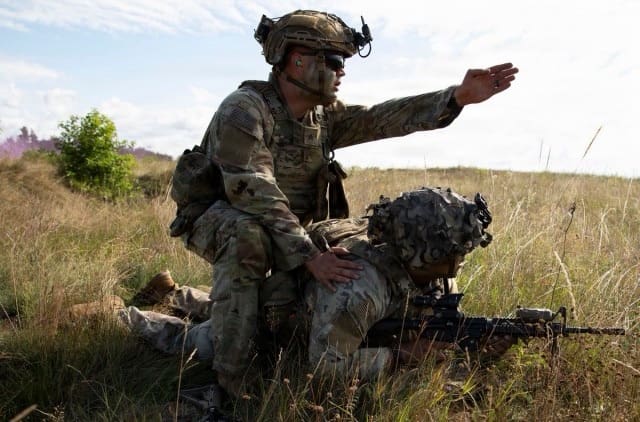



With more than 30 countries officially using either the MultiCam camouflage pattern or a derivative, it has easily become the most successful pattern in history.
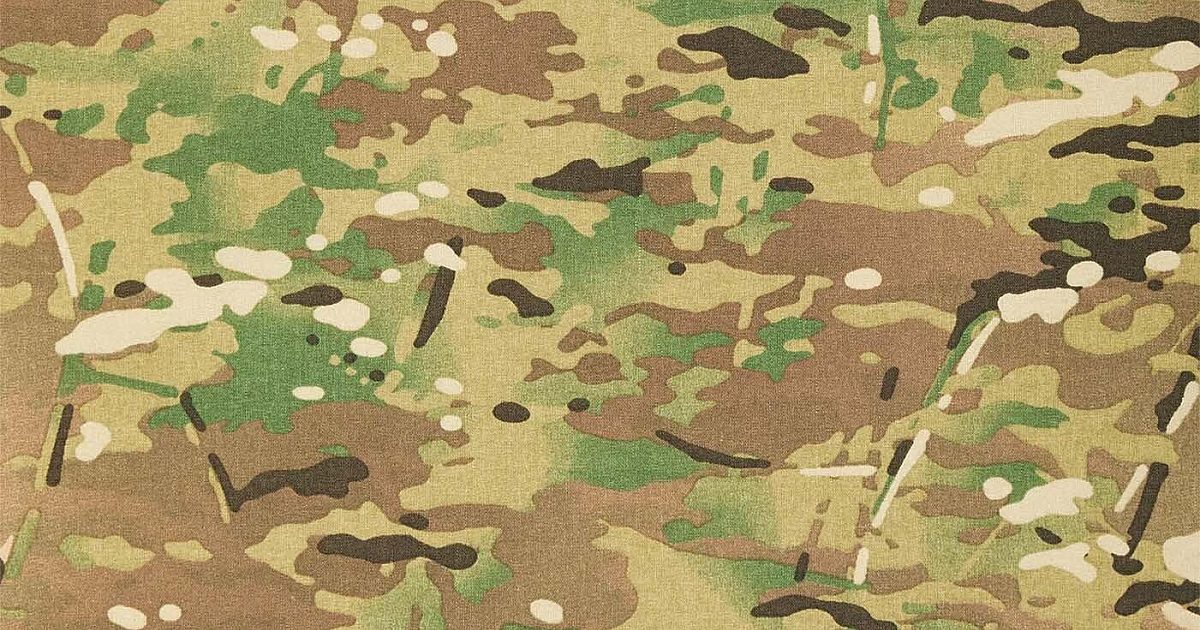
MultiCam is a multi-environmental camouflage pattern incorporating gradient shade colors, blending brown to light tan, overlaid with dark green, olive green, lime green, dark brown, and cream shapes one into another as we’d see in the wild.
This innovation was developed just after the beginning of the new millennium by a small design firm based in Brooklyn, named after one of its founders, Crye Associates.
Caleb Crye and Gregg Thompson met while studying Industrial Design at Cooper Union University. They established Crye Associates in 2000 and immediately set to work. Early on they caught the eye of the U.S. Army’s Natick Labs located just outside of Boston and were selected to participate in an ambitious modernization effort called “Objective Force Warrior (OFW),” which promised to completely reoutfit the soldier from the helmet atop his head to the soles of the boots on his feet and everything in between. The Crye team put forward revolutionary body armor and uniform designs, elements of which are still in service decades later. The most significant innovation to come out of that development effort is what is now known as the MultiCam camouflage pattern.
Introduced as what Crye Associates referred to as a “proprietary camouflage pattern,” it was initially referred to as “Scorpion” due to the nickname of the OFW ensemble it was applied to.
Around the same time Crye unveiled MultiCam, the U.S. Army was conducting a program to adopt the next camouflage pattern to replace the Woodland pattern, which had been in use since 1981. It was optimized for use in Northern Europe but pulled duty pretty much everywhere and was supplemented by a three-color desert pattern for use in arid climates. The Army’s plan was to create a family of patterns with common geometry and different color schemes to match various climates.
The MultiCam pattern itself was unveiled in 2002 and began to see use with select Special Operations Forces units in 2004. Around this same time, Crye Associates became Crye Precision. By 2006, MultiCam was showing up regularly in Afghanistan and Iraq, and not long after, it was adopted by U.S. and Allied SOF due to the pattern’s colors and shapes blending across Afghanistan’s varied terrain.
In the meantime, the U.S. Army abandoned all of the research and testing surrounding their turn-of-the-century camouflage program and decided instead to adopt a digital pattern on the Army’s birthday on June 14th, 2004. Betting on future conflicts being in urban environments, this new gray-based pattern was made up of small squares arranged to create a larger “macro pattern.” Following the lead of the Marine Corps, who also adopted the digital MARPAT camouflage in Woodland and Desert color schemes, the Army deviated by preferring a “universal” single pattern which they claimed would work anywhere. Unfortunately, the unusual coloration only seemed to work in gravel pits. Overall, it was hated by the troops, resulting in a renewed interest in camouflage.
While the Army attempted to save face by evaluating a modified version of their Universal Camouflage Pattern with added brown pixels to better blend in with Afghanistan, ultimately, the Army adopted MultiCam as an interim Operation Enduring Freedom camouflage pattern in 2010.
Deferring a wholesale adoption of MultiCam, the Army evaluated multiple commercial camo patterns and entered into negotiations to buy MultiCam from Crye Precision, who preferred to use a licensing scheme. Negotiations broke down, and eventually, the Army adopted a variant of the original Scorpion pattern from the OFW program called W2 in order to avoid paying any fees to Crye Precision. Consequently, the Army designated this variant as Operational Camouflage Pattern (OCP) and restricted its use to government only.
Scorpion W2’s colors remain the same as MultiCam, but some vertical elements are missing, resulting in lower performance. However, MultiCam and OCP work well with one another, which means that the commercial gear many soldiers use is made from genuine MultiCam-pattern fabric.
Eventually, the U.S. Air Force and Space Force joined the Army in adopting OCP as their official pattern, while SOF elements, regardless of service, use the MultiCam pattern. Other allied nations have likewise adopted MultiCam or commissioned Crye Precision to create modified national variants for their use. For example, the British Multi Terrain Pattern imported some shapes from their previous pattern, which was called Disruptive Pattern Material. They’ve been joined by Australia, Ireland and others.
These so-called national patterns have been so popular that Crye Precision created a proprietary software to depict how an altered pattern (or any camouflage pattern) will perform in various environments. I recently saw a demonstration of the software in Germany by Gregg Thompson, and it was quite sophisticated.
While there are always rumblings of various military units looking for new camouflage patterns, MultiCam works and works well. Some might say that Crye Precision is a victim of their own success. It’s hard to improve on something that performs so well.
Granted, they’ve developed specialty variants for arid, tropical, and alpine use as well as national patterns for a number of clients, but those remain limited in use compared to the millions of uniforms and ancillary equipment issued to forces around the world. And that’s not to mention MultiCam’s popularity with non-military customers, such as police and the civilian market. MultiCam is so successful it has found its way onto fashion runways.
Flattery may be the best compliment, but many of our foes have adopted MultiCam due to its effectiveness, while others have created their own patterns with similar shapes and colors. That’s not to mention the companies who knock MultiCam off purely for profit. Crye Precision continues to maintain control of the pattern’s intellectual property through the MultiCam brand, which they defend internationally from piracy.
The future requires multispectral camouflage properties. As those capabilities are incorporated into the pattern, MultiCam promises to continue to remain both popular and effective for many years to come.
Read the full article here