








The war on Iran entered its 22nd day Saturday, a day after President Donald Trump said the U.S. was considering “winding down” military operations. Trump repeated the claim Friday night on Truth Social, saying Washington was “getting very close to meeting our objectives,” despite the continued obstruction of the Strait of Hormuz.
Reuters reported Friday that the U.S. is preparing to deploy two Marine Expeditionary Units to the Middle East, with an estimated 2,500 servicemembers in each.
Anonymous officials told multiple outlets Thursday and Friday that the U.S. is considering sending ground troops inside Iran. Potential plans reportedly include deploying U.S. troops to occupy or blockade Kharg Island, a hub for the Iranian oil industry, among other options.
On Friday afternoon, U.S. Treasury Secretary Scott Bessent announced what the department called a “narrowly tailored, short-term authorization” to allow the sale of “Iranian oil currently stranded at sea,” previously under U.S. sanctions. Bessent claimed that “temporarily unlocking this existing supply for the world” would quickly bring 140 million barrels of oil to global markets and help ease what he called “temporary pressures on supply” caused by the war.
The International Energy Association departed from Bessent’s assessment that pressures would be “temporary,” warning the Financial Times that the Iran War poses “the greatest global energy security threat in history.” The IEA chief Fatih Birol warned that politicians and markets still underestimate the scale of the crisis, saying the disruption would continue to worsen each day that Middle East energy exports remained trapped by Iran’s effective blockade. Even if the conflict ended and the strait reopened, it would take “a long time” to restore damaged or shuttered oil and gas facilities—“six months for some to be operational, others much longer,” the IEA head said.
A spokesman for Iran’s Ministry of Petroleum responded on X to the temporary U.S. sanctions relief, arguing that the measure would have little effect on global oil supply since “Iran essentially has no crude oil left floating on water or surplus for supply.” The Iranian oil ministry characterized the U.S. Treasury Secretary’s statement as “merely aimed at giving hope to buyers and psychologically controlling the markets.”
Subscribe Today
Get daily emails in your inbox
Gas prices continued to rise on Saturday, with AAA reporting the national average gas price at $3.93.
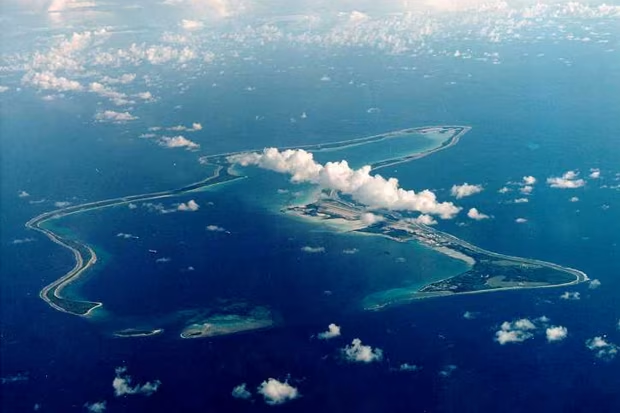
Iran’s Revolutionary Guards said Saturday that it targeted more than 55 U.S.- and Israeli-linked sites across the region, including five U.S. facilities in Saudi Arabia, the UAE, Kuwait, Iraq, and Bahrain, as well as sites in Haifa and the Tel Aviv area. The IRGC said the attacks used missiles and drones as part of an ongoing “attrition” campaign. Iran targeted American assets on the British-held island of Diego Garcia, demonstrating a longer range on their ballistic missiles than previously seen.
As Israel continues its ground invasion and bombing of Lebanon, Lebanon’s Health Ministry said two Israeli double-tap strikes hit rescue workers in Deir al-Zahrani in southern Lebanon as they responded to an earlier attack, wounding at least 21 people, including nine health workers. The ministry condemned what it called the repeated targeting of medical crews, noting that more than 40 healthcare workers have been killed since March 2.
Read the full article here


![[Alert] U.S. Bombs Iran – Retaliation Incoming](https://www.theamericanconservative.com/wp-content/uploads/2026/06/GettyImages-2267404961-scaled.jpg "[Alert] U.S. Bombs Iran – Retaliation Incoming")