



As the two-week ceasefire in the Iran War entered its third day Friday, it remained unclear whether the Iranian delegation would head to Islamabad for scheduled talks with the United States. The uncertainty comes after Israel launched its largest bombing campaign yet against Lebanon. The 10-point plan to end the war, proposed by Iran and accepted by President Donald Trump Tuesday, included an end to all Israeli strikes against Lebanon.
Iran’s Foreign Ministry said Friday that the Islamabad talks would not proceed unless Washington halted Israeli strikes on Lebanon. The spokesman Esmaeil Baqaei said that “any talks are conditional upon obtaining assurance of the U.S.’ fulfillment of its obligations regarding a ceasefire on all fronts.” Baqaei said the halt to fighting in Lebanon was “an integral part of the ceasefire understanding proposed by Pakistan” and that the composition of Iran’s delegation would only be announced once travel plans were finalized.
In a statement released by Tasnim News Agency, Iran’s Khatam al-Anbiya Central Command said its forces remained fully combat-ready with their “finger on the trigger,” citing what it called repeated failures by the U.S. and Israel to honor their commitments.
Iran’s Speaker of Parliament Mohammad Bagher Ghalibaf said in a Friday morning post on X that negotiations would not begin until there is “a ceasefire in Lebanon and the release of Iran’s blocked assets prior to the commencement of negotiations.”
The Israeli military chief Eyal Zamir told troops in southern Lebanon on Friday that the campaign had become the army’s “primary operational focus” and vowed to expand operations in Lebanon. “We are not in a ceasefire on the northern front,” he said, adding that Israel could return to striking Iran “at any moment, and with great intensity.”
The death toll from Wednesday’s Israeli airstrikes in Lebanon rose above 300 as rescue workers continued pulling bodies from the rubble, the Health Ministry said Thursday, with more than 1,150 wounded.
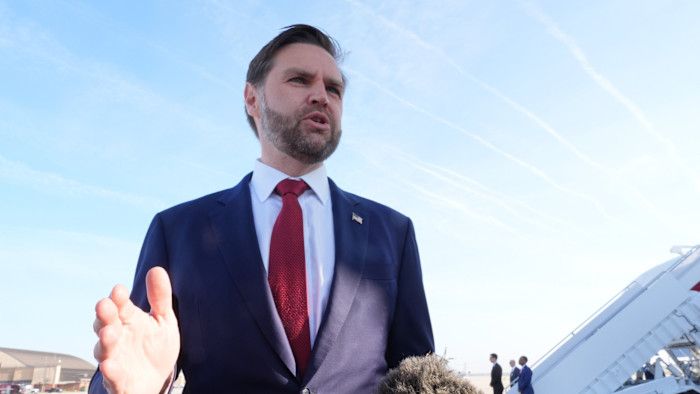
Boarding Air Force II on Friday morning for negotiations in Islamabad, Vice President J.D. Vance said that he expects the talks with Iran “to be positive.”
“If the Iranians are willing to negotiate in good faith,” Vance said, “we’re certainly willing to extend the open hand. If they’re going to try to play us, then they’re going to find the negotiating team is not that receptive.”
Vance, Steve Witkoff, and Jared Kushner will lead the U.S. negotiating team in Pakistan. A Gulf diplomat with knowledge of February’s talks to reach a nuclear deal told the Guardian, “We regarded Witkoff and Kushner as Israeli assets that dragged a president into a war he wants to get out of.”
Subscribe Today
Get daily emails in your inbox
In a Thursday evening Truth Social post, Trump warned Iran against charging fees for passage through the Strait of Hormuz, writing that “they better not be and, if they are, they better stop now!” Trump had previously floated the idea of a “joint venture,” between Iran and the United States to collect tolls in the strait. Under the 10-point plan, which Trump agreed to on Tuesday, Iran would retain control over the Strait of Hormuz along with Oman.
Traffic through the Strait of Hormuz remains extremely limited. MarineTraffic reported on Thursday that a Gabon-flagged tanker, the MSG, became the first non-Iranian vessel to carry oil through the Strait of Hormuz since the ceasefire began. Only nine vessels total transited Wednesday and Thursday combined, against a prewar daily average of more than 135, per S&P Global Market Intelligence.
Iran’s Deputy Foreign Minister Saeed Khatibzadeh said in an interview with ITV News Thursday that all vessels must now coordinate with Tehran to be guided along safe routes due to mines Iran deployed throughout the strait during the war. “We have to be very careful for the safety and security of tankers and vessels,” he said, adding that mines “take time to be removed” and that only Iranian authorities hold maps of the obstacles.
Read the full article here
