







Understanding Terminal Ballistics: Why Caliber Matters
When evaluating a rifle platform for serious defensive or precision applications, the conversation inevitably turns to terminal ballistics — what the projectile actually does after it leaves the barrel and encounters a target. Muzzle velocity and energy figures printed on ammunition boxes tell only part of the story. The more consequential question is how much of that energy is retained downrange, and how effectively the projectile performs when it must defeat intermediate barriers before reaching its intended target.
The comparison between .308 Winchester (7.62×51mm NATO) and 5.56×45mm NATO is one of the most studied and debated topics in practical marksmanship. Both cartridges are capable, well-documented, and widely fielded. However, when the operational context involves extended ranges, hardened cover, or vehicle panels, the physical properties of the .308 Winchester create measurable, repeatable advantages that deserve careful examination.
The Physics of Retained Energy
Energy retention over distance is a function of a projectile’s ballistic coefficient (BC), sectional density, and initial velocity. A heavier, longer bullet with a higher BC sheds velocity more slowly as it travels through air. This is where the .308 Winchester begins to separate itself from the 5.56 NATO in a meaningful way.
- A standard 62-grain M855 5.56 NATO projectile leaves the muzzle at approximately 3,020 feet per second (fps) with roughly 1,255 foot-pounds (ft-lbs) of energy.
- A standard 168-grain .308 Winchester match projectile departs at approximately 2,650 fps, generating around 2,620 ft-lbs of muzzle energy.
- At 500 meters, the 168-grain .308 projectile retains approximately 1,400 ft-lbs of energy, while the 62-grain 5.56 has diminished to roughly 550 ft-lbs under comparable atmospheric conditions.
The practical implication is significant. At distances where many 5.56 projectiles have lost the velocity required for reliable fragmentation — generally considered to be below approximately 2,700 fps — the .308 Winchester continues to deliver energy sufficient to produce reliable terminal effects. This threshold velocity for 5.56 fragmentation is typically reached somewhere between 150 and 300 meters depending on barrel length, meaning the cartridge’s primary wounding mechanism becomes less dependable at the ranges where the .308 is still performing predictably.
Barrier Penetration: Defeating Cover
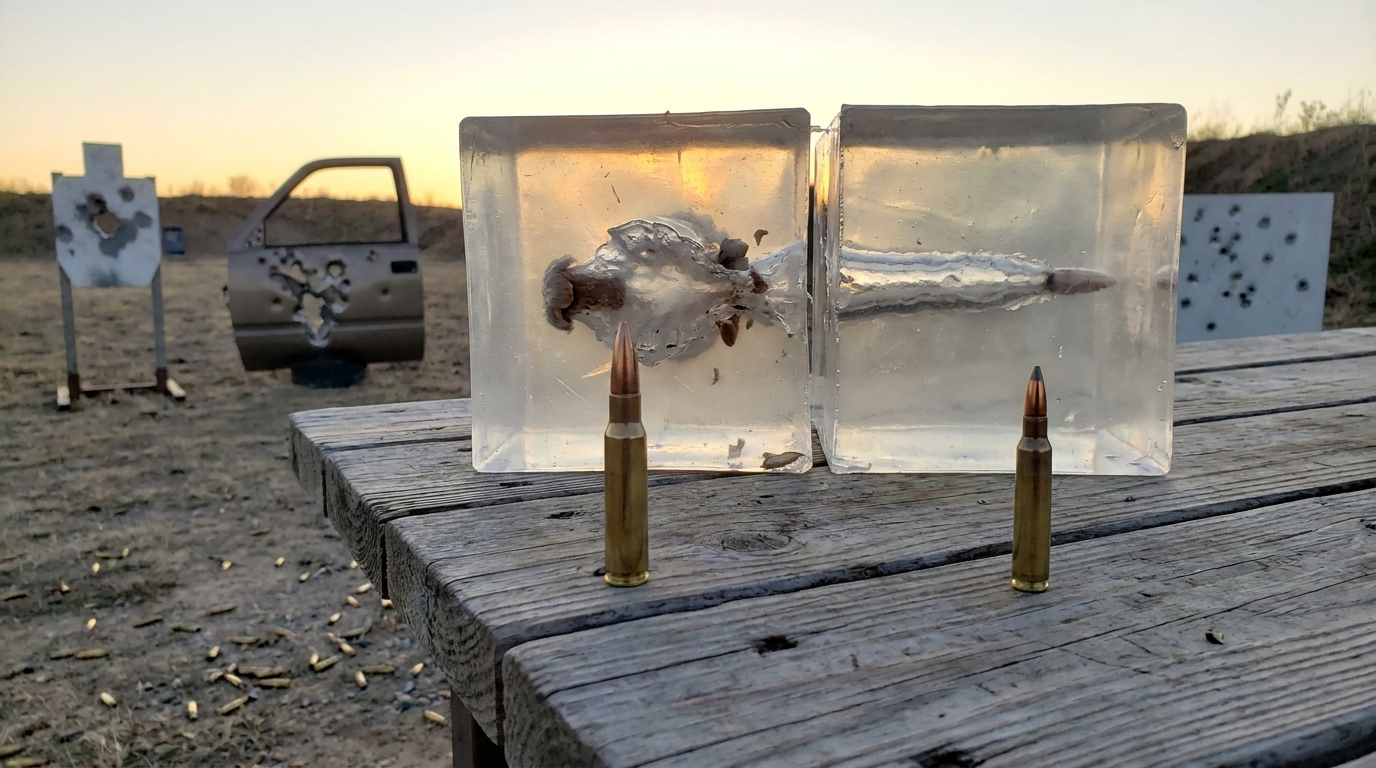
In a tactical context, the distinction between cover and concealment is foundational. Concealment hides a target; cover is intended to stop or deflect projectiles. The reality, however, is that many objects people instinctively use as cover — automobile doors, cinder block walls, wooden framing, and even light steel panels — can be defeated by rifle fire. The question is which cartridge defeats them more reliably.
The .308 Winchester’s heavier projectile carries substantially greater momentum, which is the primary driver of barrier penetration. Momentum is mass multiplied by velocity, and while the 5.56 NATO achieves high velocity, the mass deficit compared to .308 becomes a critical limitation when the projectile must maintain its trajectory through a dense intermediate barrier.
- Automobile glass and sheet metal: Both cartridges will penetrate standard vehicle doors, but .308 projectiles demonstrate significantly less deflection after passing through laminated windshield glass at oblique angles — a common real-world scenario.
- Cinder block and masonry: The .308 Winchester is far more likely to maintain lethal velocity and trajectory after passing through a single course of standard cinder block. The 5.56 typically fragments severely or is deflected upon contact with masonry.
- Ballistic-rated materials: NIJ Level III body armor is specifically rated to defeat 7.62×51mm NATO at standard velocities. However, unarmored hard cover that falls below that specification is defeated far more consistently by .308 than by 5.56.
Extended Range Performance Beyond 500 Meters
The AR-15 platform chambered in 5.56 NATO is a highly capable carbine within its effective envelope, which most authorities place at approximately 300 to 500 meters for trained shooters using quality ammunition and appropriate barrel lengths. Beyond that range, the cartridge’s transonic transition — the point at which a bullet slows from supersonic to subsonic flight, typically around 1,340 fps — introduces instability and unpredictability in terminal performance.
The .308 Winchester, particularly when loaded with high-BC projectiles such as the 175-grain Sierra MatchKing or comparable offerings from other manufacturers, remains supersonic well past 800 meters and in some loadings past 1,000 meters. This extended supersonic range means the shooter retains predictable ballistic behavior, reliable terminal performance, and sufficient energy for effect on target at distances where 5.56 has effectively exhausted its practical utility.
For precision rifle applications — whether in a designated marksman role, a long-range hunting context, or competitive precision shooting — this difference is not theoretical. It is the difference between a cartridge that delivers reliable, consistent results at distance and one that requires the shooter to work within tighter constraints to achieve the same outcome.
The AR-10 Platform as a Delivery System
The AR-10, originally designed by Eugene Stoner prior to the development of the AR-15, chambers the .308 Winchester in a familiar semi-automatic platform that shares much of its manual of arms with the smaller AR-15. Shooters already proficient with the AR-15 will find the controls, maintenance procedures, and general handling characteristics largely transferable, which reduces the training burden associated with adopting a more powerful cartridge.
Modern AR-10 variants from manufacturers such as LWRC International, Daniel Defense, Knights Armament Company, and Aero Precision have addressed many of the early platform’s limitations in terms of reliability and weight. While the AR-10 is heavier and produces greater recoil than an AR-15, these are manageable trade-offs for a shooter who has identified a genuine need for the terminal performance the .308 Winchester provides.
Standard AR-10 magazines are available in capacities of 10, 20, and 25 rounds, and the platform accepts a wide variety of optics, suppressors, and accessories that have become standard in the precision rifle community.
Acknowledging the Trade-offs
An honest assessment requires acknowledging what the .308 Winchester costs the shooter in exchange for its ballistic advantages. These are real considerations, not dismissible drawbacks.
- Weight: A loaded 20-round .308 magazine weighs significantly more than a comparable 30-round 5.56 magazine. For a shooter carrying multiple magazines over extended distances, this weight accumulates rapidly.
- Recoil: The .308 Winchester produces noticeably greater felt recoil than 5.56 NATO, which can affect split times and follow-up shot accuracy for less experienced shooters.
- Platform size and weight: The AR-10 is a larger, heavier rifle than the AR-15. In confined spaces or during high-mobility operations, this size difference is a genuine liability.
- Ammunition cost: Quality .308 Winchester ammunition is more expensive per round than comparable 5.56 NATO, which has practical implications for training volume.
These trade-offs explain why military and law enforcement organizations have not universally abandoned 5.56 NATO. For many applications — close-quarters engagements, high-volume fire, light infantry operations — the 5.56 NATO’s lower weight, reduced recoil, and adequate terminal performance within its effective range represent a rational choice. The argument for .308 Winchester is not that it is universally superior, but that it is specifically superior in the scenarios described: extended ranges, barrier penetration, and engagements against hardened cover.
Making the Caliber Decision
The decision between .308 Winchester and 5.56 NATO should be driven by an honest assessment of the shooter’s likely operational environment and the distances and barriers they may reasonably anticipate. A shooter whose primary concern is home defense or close-range competition has little practical use for the .308 Winchester’s extended-range performance. A shooter who operates in open terrain, anticipates engagements beyond 400 meters, or requires reliable penetration of vehicle panels and light structural materials will find the .308 Winchester’s terminal ballistics to be a genuine and measurable advantage.
Terminal ballistics ultimately comes down to what the projectile delivers at the point of impact, under real-world conditions, against realistic targets. By that standard, the .308 Winchester — delivered through a well-built AR-10 platform — represents a compelling choice for those whose requirements extend beyond what the 5.56 NATO cartridge was designed to provide.

