


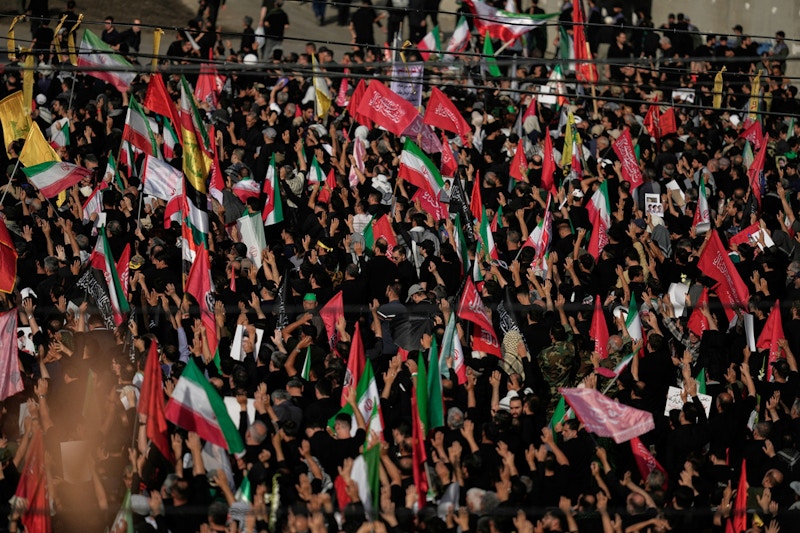

The dayslong funeral for Iran’s former Supreme Leader Ayatollah Ali Khamenei officially kicked off on Saturday, drawing massive crowds, as negotiations to end the Iran War entered their 17th day. Up to 30 million mourners are expected to gather in Iran at some point to pay respects to Khamenei, who was assassinated by the U.S. and Israel on February 28, with senior officials from Pakistan, Saudi Arabia, Qatar, Russia, and China reportedly present.
Al Arabiya, citing anonymous sources, reported on Saturday that the next round of negotiations between the U.S. and Iran are scheduled for July 11 in Pakistan.
Iran’s Deputy Foreign Minister Kazem Gharibabadi warned on Saturday against the presence of what he labeled “extra-regional powers” in the Strait of Hormuz. Iran’s central military command had declared Thursday that all vessels transiting the Strait of Hormuz must follow routes designated by the Iranian government or face an “immediate and forceful response.”
Global energy markets experts noted Saturday that vessels transiting the strait appeared to be moving away from the route close to Oman and toward the Iranian route.
The Iranian Deputy FM’s remarks follow a joint statement made by UK Prime Minister Keir Starmer and French President Emmanuel Macron Friday, which said that “the U.K. and France also stand ready to deploy the wider Multinational Military Mission to support freedom of navigation in the Strait of Hormuz.”
The Financial Times reported that many mourners at the funeral of Khamenei expressed frustration with and opposition to the Iranian government’s pursuit of a negotiated settlement to end the conflict.
President Donald Trump said Friday, in a speech at Mount Rushmore one day before the 250th anniversary of the Declaration of Independence, “We beat Venezuela in one day and we knocked the hell out of Iran. They’re dying to settle.”
Subscribe Today
Get daily emails in your inbox
Speaking at a joint press conference with Pakistani Prime Minister Shehbaz Sharif, Turkey’s President Recep Tayyip Erdoğan criticized what he called “the war-addicted current Israeli government,” accusing the Israeli cabinet of tying “its political survival to the continuation of conflicts in the region…not leaving Lebanon and Syria alone in particular,” while also noting that “Israeli occupation forces continue their unlawful and inhumane attacks against the oppressed in Gaza.”
Erdoğan’s comments come after various threats against Turkey made by several Israeli lawmakers in recent weeks. Israel’s Minister of Diaspora Affairs Amichai Chikli said at the JNS International Policy Summit in June that “Turkey of Erdogan and Syria of al-Sharaa are now far more concerning than Iran.” Israel’s Culture and Sports Minister Miki Zohar said in May that Israel “must begin to treat Turkey as an enemy state,” while Naftali Bennett, a former prime minister of Israel and candidate in Israel’s October elections, said in February that “Turkey is the new Iran.”
In a post on X, Iran’s mission to the UN commemorated the July 3, 1988 incident in which the U.S. Navy shot down an Iranian passenger plane, “killing all 290 civilians on board—including 66 children.” The Iranian government account related the incident to the “Tomahawk missiles that struck the school in Minab, killing 168 schoolchildren,” on February 28 of this year, which Iran said the U.S. also “refuses to answer for.”
Read the full article here
